

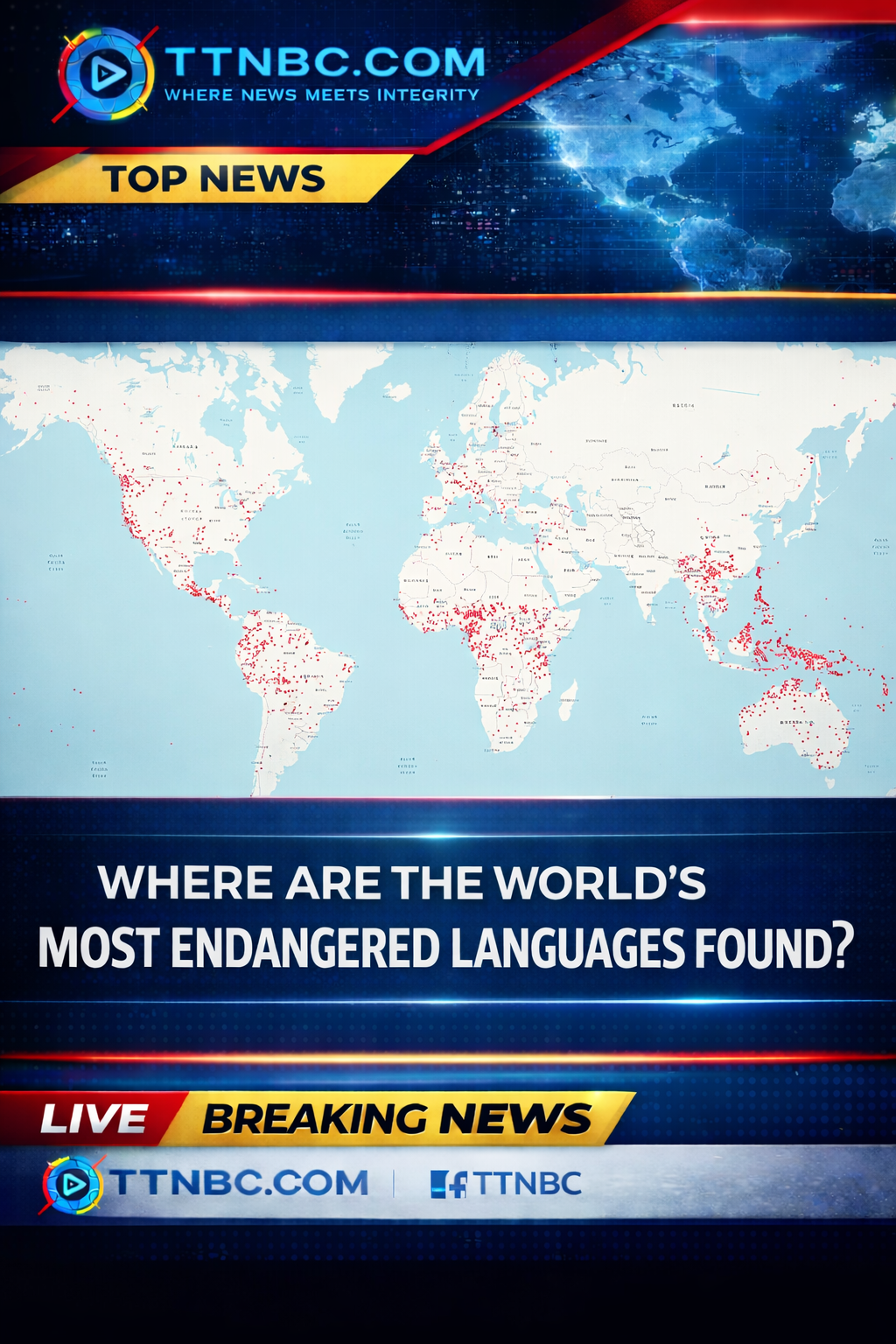
February 21 is observed as World Mother Language Day, a global event dedicated to celebrating linguistic diversity and promoting the protection of native languages. Today, more than 7,000 languages are spoken worldwide. However, experts warn that nearly 3,000 of these languages — about 40 percent — are endangered, meaning they could disappear within the next few generations.
English currently holds the position of the most widely spoken language, with around 1.5 billion speakers across 186 countries. Interestingly, only about 20 percent of English speakers use it as their native language, while the remaining 80 percent speak it as a second, third, or additional language, according to data from Ethnologue, one of the world’s most trusted language databases.
Mandarin Chinese follows closely as the second most spoken language, with nearly 1.2 billion speakers. However, when counting native speakers alone, Mandarin becomes the largest language globally, mainly due to China’s massive population.
In third place is Hindi, spoken by approximately 609 million people, followed by Spanish with 559 million speakers, and Standard Arabic, which has around 335 million speakers worldwide.
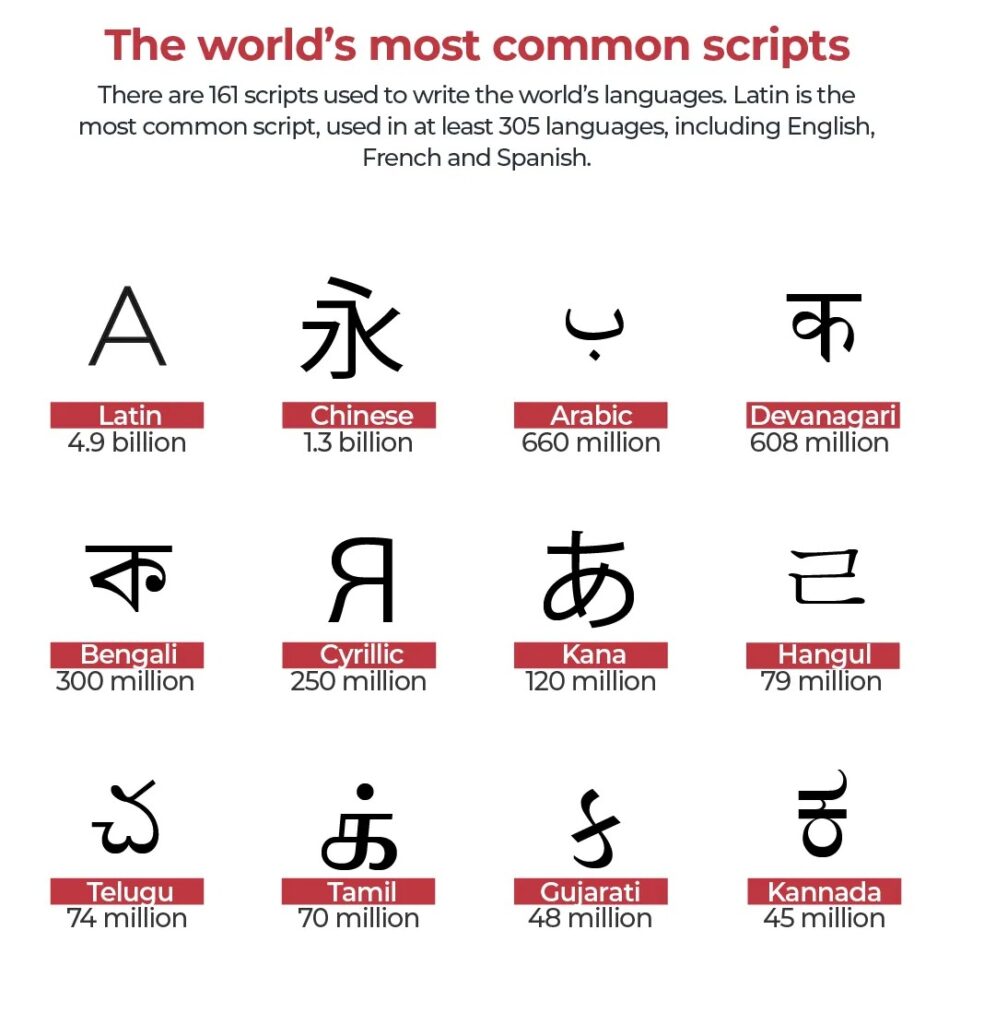
Scripts in the world’s most popular languages
Languages are recorded and transmitted using scripts — sets of written characters. According to The World’s Writing Systems, there are 293 known writing scripts in total. Out of these, more than 156 scripts are still actively used, while 137 historical scripts, including Egyptian hieroglyphs and Aztec pictograms, are no longer in practice.
The Latin script stands out as the most widely used writing system. It is employed by major global languages such as English, French, Spanish, German, and many others. This script is used by at least 305 of the world’s 7,139 known living languages, and over 70 percent of the global population reads and writes using it.
Which are the most endangered languages?
Out of 7,159 languages spoken worldwide, nearly 3,193 languages (44 percent) are classified as endangered. Meanwhile, 3,479 languages (49 percent) remain stable, and 487 languages (7 percent) are considered institutional — meaning they are actively used in official settings such as government, education, and media.
A language becomes endangered when communities gradually stop passing it down to younger generations, often replacing it with more dominant national or international languages. Many endangered languages survive only as secondary languages used by older generations.
Ethnologue estimates that 337 languages are currently dormant, meaning they no longer have fluent speakers but still hold cultural significance. Meanwhile, 454 languages are officially extinct, with no remaining speakers or cultural continuity.
Globally, 88.1 million people still speak an endangered language as their first language. Among them:
1,431 languages have fewer than 1,000 speakers
463 languages have fewer than 100 speakers
110 languages have fewer than 10 speakers
Remarkably, just 25 countries account for nearly 80 percent of all endangered languages. Oceania has the highest number, followed by Asia, Africa, and the Americas.
Some endangered languages include:
Oceania
In Australia, Yugambeh, an endangered Aboriginal language, is spoken by the Yugambeh people mainly across the Gold Coast, Scenic Rim, and Logan regions. Community-driven revitalization efforts, supported by digital learning tools and mobile apps, have helped younger generations reconnect with their linguistic roots.
Asia
In Japan, Ainu (Ainu Itak) is considered critically endangered. UNESCO reports that it does not clearly belong to any known language family. Although exact speaker numbers are uncertain, a 2006 survey revealed that only 304 individuals out of nearly 24,000 Ainu people had knowledge of the language.
Africa
In Ethiopia, Ongota is on the verge of extinction. Traditionally spoken by a small community along the Weito River, only a handful of elders now use the language. With approximately 400 community members left, Ongota faces an uncertain future.
Americas
Across North and Central America, most Indigenous languages are endangered. In the United States, Louisiana Creole, influenced by French, African, and Indigenous cultures, is now spoken mainly by elderly populations.
In Bolivia, Leco, an isolated Indigenous language with no known linguistic relatives, is spoken by only a few elders among a total ethnic population of around 13,500, making preservation efforts especially urgent.
Europe
Cornish (Kernewek), spoken in southwest England, was once declared extinct by UNESCO. However, revival programs led to its reclassification as endangered in 2010. According to the 2021 England and Wales census, 563 people now speak Cornish as their first language — a hopeful sign for linguistic revival.
Conclusion:
World Mother Language Day highlights the urgent need to protect endangered languages, as each one carries unique history, identity, and cultural knowledge. Without timely action, thousands of languages could vanish, taking centuries of human heritage with them.