

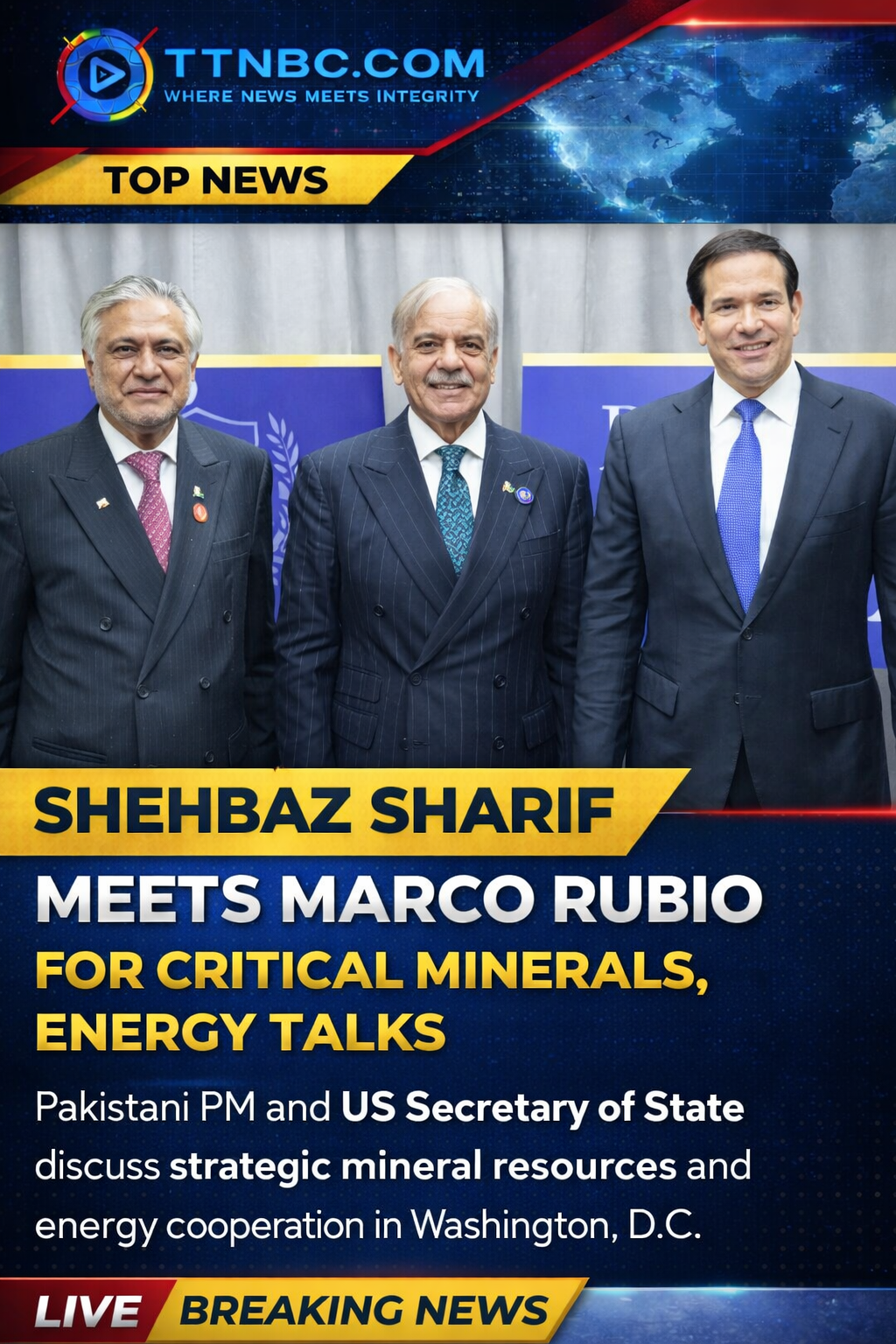
The recent meeting between Prime Minister Shehbaz Sharif and US Secretary of State Marco Rubio in Washington marked a significant moment in Pakistan–United States relations, highlighting renewed engagement in key areas such as critical minerals, energy cooperation, and counterterrorism. While official statements remained diplomatic in tone, the substance of the discussions reflected shifting global priorities and Pakistan’s evolving economic strategy.
The talks followed Pakistan’s participation in the inaugural Critical Minerals Ministerial, a high-level international forum bringing together countries to address growing global demand for strategic resources. These minerals — including copper, lithium, and rare earth elements — now play a central role in modern technologies, renewable energy systems, electric vehicles, and defence industries. Their importance has transformed them into highly sought-after commodities, driving competition among major global powers.
Pakistan’s involvement in the ministerial signalled a clear intention to reposition itself as a potential supplier within this expanding global supply chain. Officials highlighted the country’s untapped mineral reserves and expressed openness to foreign investment, particularly from the United States, alongside existing partnerships with China and other nations. The message was straightforward: Pakistan seeks to become an active participant in the global minerals market rather than remaining on its margins.
However, optimism surrounding mineral development comes with significant challenges. Pakistan’s past experiences demonstrate that natural resource wealth does not automatically translate into widespread prosperity. Transparency, accountability, and equitable benefit-sharing remain critical concerns. Historically, major resource projects have often lacked public disclosure, leaving citizens uncertain about long-term economic and environmental impacts.
One frequently cited example is the extraction of natural gas from Sui in Balochistan, which fueled industrial and household growth across the country for decades. Despite this, the province itself saw limited economic development, creating long-standing grievances. This experience underscores the importance of inclusive planning, transparent contracts, and community involvement in future mining ventures.
As Pakistan markets its mineral potential globally, questions surrounding revenue sharing, environmental safeguards, and local employment opportunities will shape public perception. Without clear governance frameworks, new mining initiatives risk deepening economic inequality and social tension rather than delivering national progress.
These discussions unfold against a backdrop of mounting economic pressures. Recent estimates suggest nearly 29 percent of Pakistan’s population now lives below the poverty line, a sharp rise from previous years. Inflation, fiscal austerity, climate-related disasters, and sluggish growth have eroded purchasing power, placing immense strain on households. In this context, large-scale investment announcements must translate into tangible job creation, education, and infrastructure development to gain public trust.
Energy cooperation formed the second key pillar of the Washington dialogue. Over the past decade, Pakistan significantly expanded its electricity generation capacity, largely through infrastructure projects linked to the China-Pakistan Economic Corridor. While these investments alleviated chronic power shortages, they also introduced financial burdens that now contribute to high tariffs and rising circular debt.
As a result, affordability has replaced availability as the country’s primary energy challenge. Consumers face soaring electricity bills, while policymakers struggle to balance contractual obligations with economic realities. Meanwhile, a quiet shift toward rooftop solar energy has emerged across urban and rural areas. Driven by necessity, households and businesses increasingly adopt solar solutions to reduce dependence on expensive grid power.
Despite this trend, regulatory uncertainty and policy adjustments have slowed the sector’s expansion. Debates over net metering policies and tariff structures have created concerns that decentralised renewable energy is being constrained. This contradiction highlights the need for coherent energy reforms that prioritize efficiency, innovation, and consumer protection.
Effective cooperation with the United States could play a constructive role in modernising Pakistan’s energy sector. Investments in grid upgrades, renewable technologies, and transparent pricing mechanisms may help build a more sustainable and resilient energy framework. However, such progress depends heavily on domestic policy alignment and institutional reforms.
Counterterrorism, the third component of the talks, reflects a longstanding feature of Pakistan–US relations. Security cooperation has shaped bilateral engagement for decades, from the Cold War era to post-9/11 conflicts. While this partnership remains important, many Pakistanis hope to see a broader narrative emerge — one that emphasizes economic development, technological collaboration, and institutional growth.
Pakistan’s diplomatic strategy appears focused on balance. By engaging both the United States and China in its upcoming Minerals Investment Forum, Islamabad aims to diversify partnerships while avoiding geopolitical entanglements. Success will depend on consistent regulatory standards, transparent governance, and inclusive development policies.
Ultimately, mineral wealth and energy reform offer promising pathways for economic revival. Yet their true value will be measured by their impact on ordinary citizens. Transparent governance, environmental responsibility, and social inclusion must guide future decisions. Only then can Pakistan transform strategic engagement into lasting national progress.