

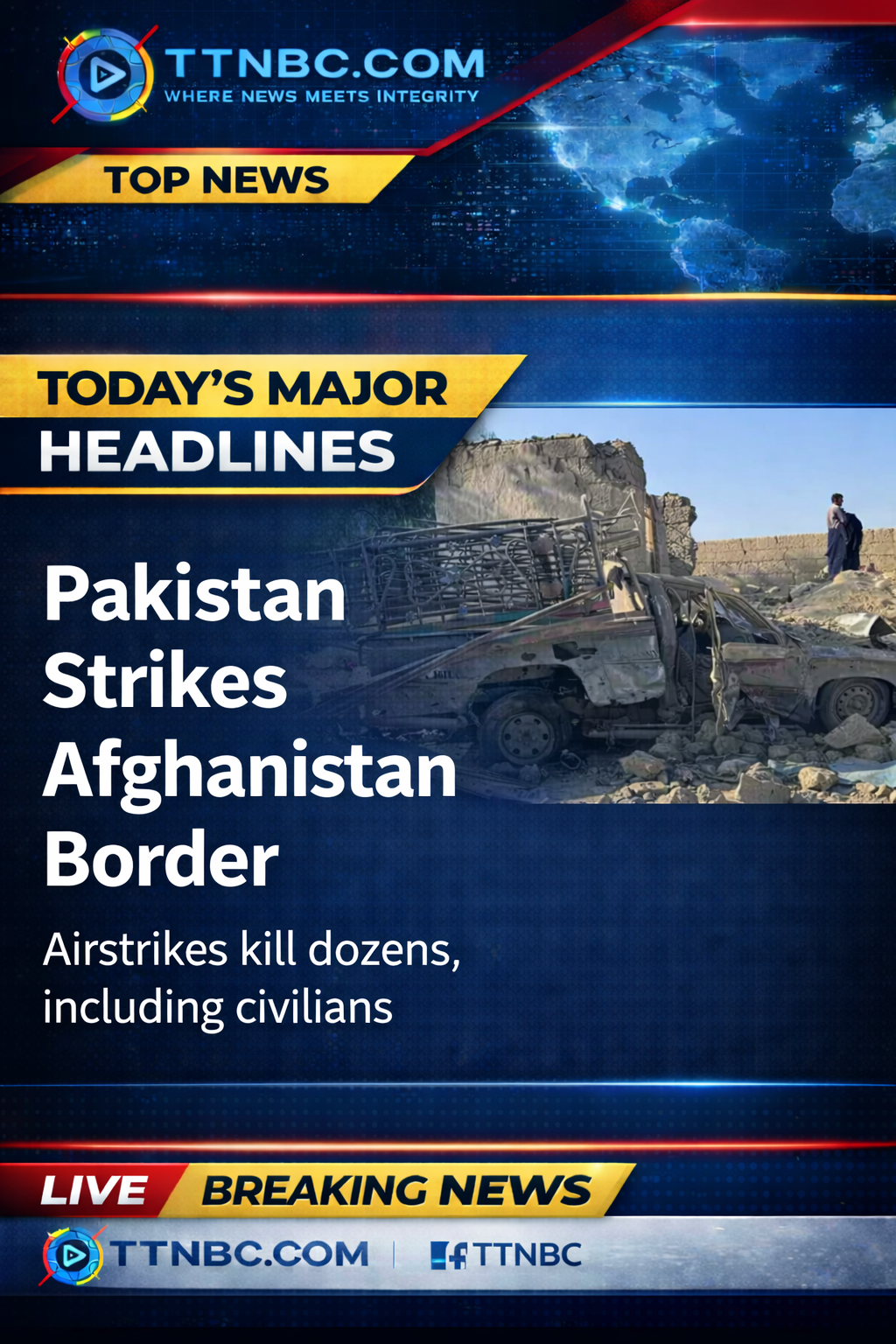
Pakistan has launched a series of overnight airstrikes inside Afghanistan, triggering a sharp reaction from the Taliban authorities, who claimed that dozens of civilians, including women and children, were killed and injured. The strikes mark a serious escalation in cross-border tensions between the two neighboring countries, already strained by militant violence and fragile diplomatic relations.
According to Pakistani officials, the military operation targeted seven suspected militant hideouts located near the Pakistan-Afghanistan border. Islamabad stated that the strikes were based on actionable intelligence and were carried out in response to recent suicide bombings inside Pakistan. These attacks, authorities say, were orchestrated by militant groups operating from Afghan territory.
Afghanistan’s Taliban-led government strongly condemned the airstrikes, accusing Pakistan of targeting civilian homes and a religious school in eastern provinces. The Taliban’s defense ministry said that residential areas in Nangarhar and Paktika provinces were hit, resulting in heavy civilian casualties. Local officials in Nangarhar reported that the home of a man named Shahabuddin was struck, killing approximately 20 members of his family, including women and children.
Pakistan’s Ministry of Information and Broadcasting described the operation as an “intelligence-based, selective targeting” of terrorist camps. In an official statement, the ministry said the targets included fighters belonging to the banned Tehreek-i-Taliban Pakistan (TTP), referred to by the government as “Fitna al Khawarij,” along with their affiliates and members of the Islamic State-Khorasan Province (ISKP).
The ministry added that the strikes were a “retributive response” to multiple deadly attacks that have rocked Pakistan in recent weeks. Among these was a suicide bombing at a Shia mosque in Islamabad earlier this month, along with several other incidents in the north-western Khyber Pakhtunkhwa province since the start of Ramadan. These attacks have intensified public pressure on the government to act decisively against militant networks.
Islamabad has repeatedly accused the Afghan Taliban of failing to take effective action against militant groups sheltering on Afghan soil. Officials claim they possess “conclusive evidence” that recent terrorist attacks inside Pakistan were planned and directed from across the border. Pakistan has urged Kabul to dismantle these networks and prevent its territory from being used for cross-border terrorism.
In response, the Taliban’s defense ministry denounced the strikes as a “blatant violation of Afghanistan’s territorial integrity” and a “clear breach of international law.” In a strongly worded statement posted on social media, the ministry warned that an “appropriate and measured response” would be delivered at a time of its choosing. It further criticized Pakistan’s intelligence capabilities, claiming that the targeting of civilian areas and religious institutions showed serious operational failures.
The latest airstrikes come despite a fragile ceasefire agreement reached in October following intense cross-border clashes. That truce was brokered after the deadliest fighting between the two sides since the Taliban returned to power in 2021. However, sporadic violence and militant attacks have continued, undermining efforts to stabilize the region.
Adding to the complexity, Saudi Arabia recently mediated the release of three Pakistani soldiers who were captured in Kabul during last year’s border clashes. Their release had raised hopes of easing tensions, but the latest developments threaten to undo diplomatic progress.
Pakistan and Afghanistan share a rugged, mountainous border stretching approximately 1,600 miles (2,574 kilometers). The porous nature of this frontier has long made it difficult to control militant movements, contributing to recurring security challenges for both nations. Despite repeated talks and security agreements, mistrust remains high, fueled by frequent accusations and retaliatory actions.
Regional analysts warn that continued escalation could further destabilize South Asia, complicating humanitarian conditions and undermining regional security. Calls are growing for renewed diplomatic engagement and international mediation to prevent the situation from spiraling into a broader conflict.
As both sides trade blame and issue warnings, the humanitarian toll remains a major concern. Civilians living near the border continue to bear the brunt of these hostilities, facing displacement, fear, and loss. Observers stress that without sustained dialogue and cooperation, cycles of retaliation are likely to persist, deepening instability across the region.