

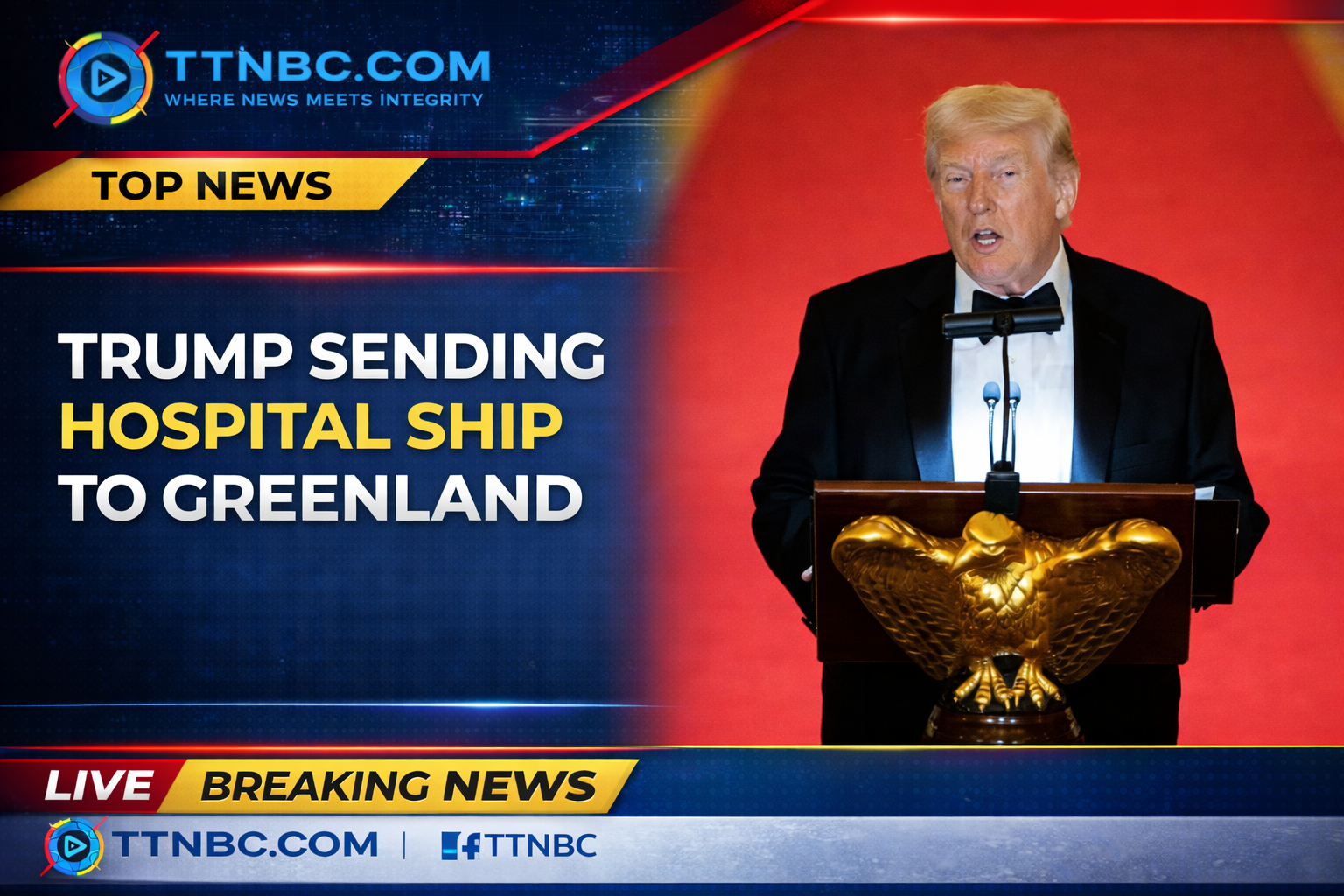
Former US President Donald Trump has announced that a US Navy hospital ship is being dispatched to Greenland, the vast Arctic island and autonomous Danish territory that he has repeatedly expressed interest in acquiring. The statement, made through social media on Saturday, quickly drew international attention and sparked fresh debate over Greenland’s strategic and political importance.
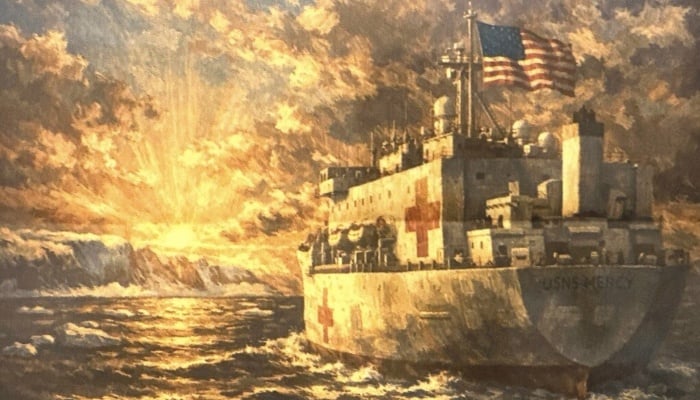
In his post, Trump said that the decision was made in coordination with Louisiana Governor Jeff Landry, whom he appointed as a special envoy to Greenland late last year. According to Trump, the hospital ship would provide much-needed medical assistance to residents who, he claimed, were not receiving proper healthcare services. He also shared an image of the US Navy’s hospital vessel, the USNS Mercy, suggesting that the ship was already en route.
However, the announcement raised immediate questions, as both Greenland and Denmark operate publicly funded, universal healthcare systems that provide free medical services to citizens. Officials in Denmark and Greenland have not indicated any urgent healthcare crisis that would require international emergency intervention.
Following Trump’s statement, media organizations reached out to the White House, the Danish Embassy in Washington, the Danish government, and Greenland’s parliament seeking clarification. The US Department of Defense redirected inquiries to US Northern Command, which then referred questions to the US Navy. As of now, no official confirmation or detailed explanation has been released regarding the mission.
Governor Jeff Landry echoed Trump’s comments in a separate social media post, expressing pride in collaborating on what he described as an “important humanitarian and strategic effort.” Still, the lack of concrete details has left analysts and observers puzzled about the true motive behind the deployment.
The US Navy currently operates two primary hospital ships — the USNS Mercy and the USNS Comfort. These floating medical facilities are typically used during military deployments, disaster relief missions, and humanitarian operations. During the height of the COVID-19 pandemic in 2020, the USNS Comfort was stationed in New York City to help relieve pressure on overwhelmed hospitals.
Greenland, known for its icy landscapes and sparse population, is home to around 56,000 residents, making it the least densely populated country in the world. Due to its challenging terrain and limited road infrastructure, transportation between towns often relies on boats, aircraft, and helicopters. Despite its remote nature, Greenland holds immense strategic value because of its location in the Arctic and its proximity to North America and Europe.
The United States already maintains a military presence on the island through the Pituffik Space Base, located on Greenland’s western coast. This base plays a key role in missile defense, space surveillance, and Arctic security operations, highlighting Greenland’s importance in global defense planning.
Trump’s renewed focus on Greenland follows his controversial efforts last month to push forward a framework for a future agreement involving the island. His remarks reportedly unsettled several European allies and revived concerns over Greenland’s sovereignty. While Trump has framed his interest in terms of security and economic opportunity, leaders in Denmark and Greenland have consistently rejected any notion of transferring control.
The idea of US leadership has also unsettled many Greenlanders. Local residents worry that becoming part of the United States could lead to significant changes in social services, particularly healthcare and education. Municipal engineer Ludvig Petersen previously told international media that he strongly opposed American control, citing fears over privatization.
“I don’t like the idea of becoming part of America,” Petersen said. “My biggest concern is the privatization of healthcare and education. These are services we depend on, and they are publicly funded. That system is very important to us.”
Experts suggest that Trump’s announcement may be part of a broader geopolitical strategy aimed at increasing US influence in the Arctic, a region that is rapidly gaining importance due to climate change, emerging shipping routes, and untapped natural resources. Russia and China have also increased their activity in the region, intensifying competition among major powers.
Whether the hospital ship deployment will actually take place remains uncertain. Without formal confirmation from the US Navy or official agencies, it is unclear if this is a humanitarian mission, a symbolic gesture, or part of a larger diplomatic move.
For now, Trump’s statement has once again placed Greenland at the center of global attention, reigniting discussions about sovereignty, healthcare systems, and the growing strategic importance of the Arctic in world politics.