

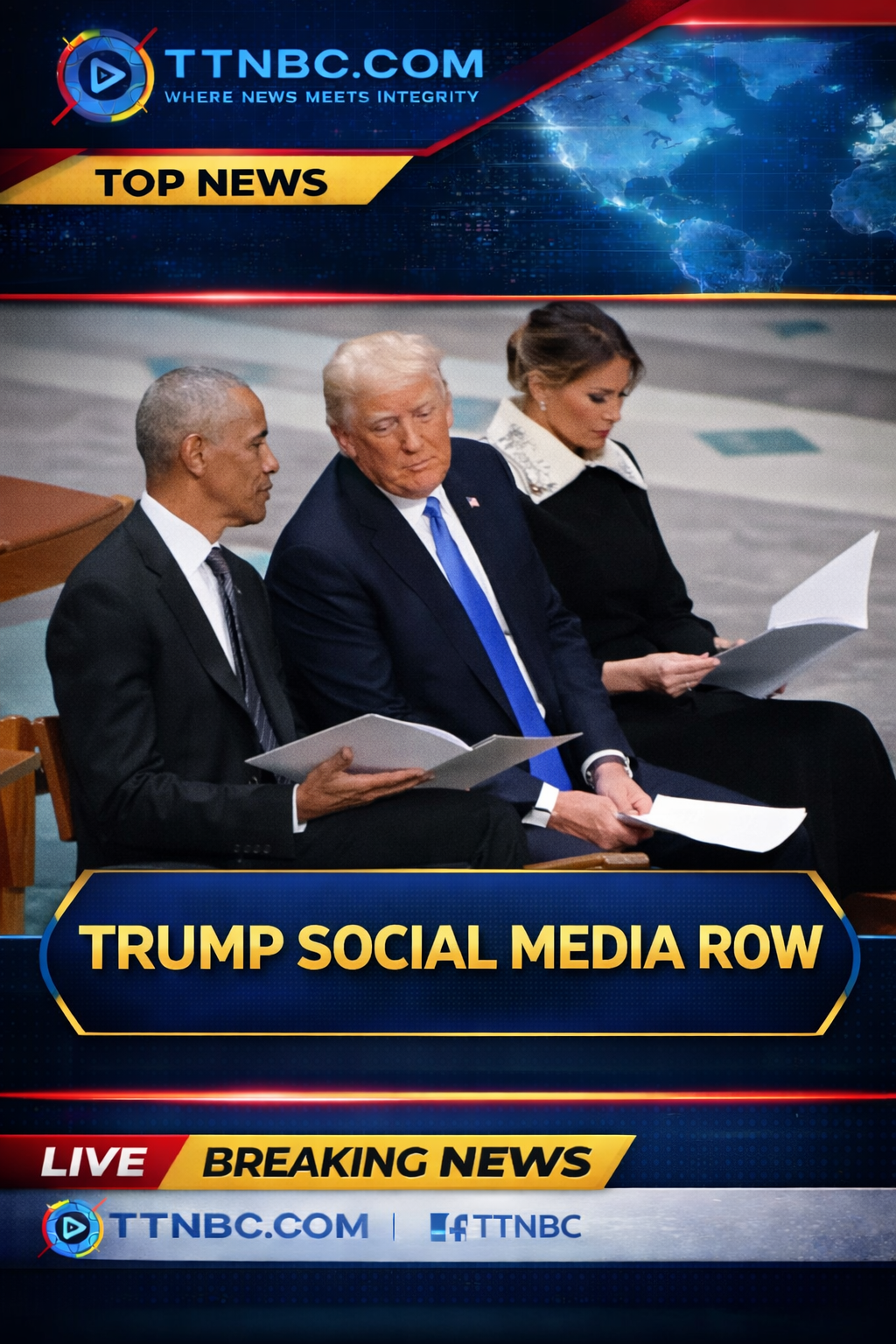
Former U.S. President Donald Trump has sparked fresh controversy after refusing to apologize for sharing a racially offensive video on his social media platform, Truth Social. The video, which was later deleted, depicted former President Barack Obama and former First Lady Michelle Obama in a deeply derogatory and racist manner. The incident has drawn widespread condemnation from civil rights groups, political leaders, and social media watchdogs across the United States.
The video briefly appeared on Trump’s Truth Social account before being taken down, but screenshots and recordings quickly circulated online. Critics described the content as blatantly racist and offensive, arguing that it reinforces harmful stereotypes and promotes racial hatred. Despite the backlash, Trump has shown no sign of regret, instead dismissing calls for an apology as politically motivated attacks.
Trump Stands Firm Amid Backlash
When asked whether he would apologize for sharing the video, Trump flatly refused. Speaking to supporters and later addressing the controversy online, the former president said he would not bow to what he described as “cancel culture” or pressure from political opponents. He framed the criticism as an attempt to silence him and his supporters, insisting that he has the right to share content freely on his own platform.
Sources close to Trump say he views the controversy through the lens of free speech, a claim that has been strongly challenged by legal experts and civil rights advocates. They argue that freedom of expression does not extend to content that dehumanizes individuals or promotes racial hatred, particularly when shared by a public figure with a massive following.
Strong Reactions From Political and Civil Rights Leaders
Democratic leaders were quick to condemn the incident, calling it irresponsible and damaging to national unity. Several lawmakers described Trump’s actions as a clear example of how inflammatory rhetoric continues to divide the country along racial lines. Some urged social media companies, including Truth Social, to strengthen their content moderation policies to prevent the spread of hate-based material.
Civil rights organizations also weighed in, stating that the video crossed a serious line. Advocacy groups warned that such content normalizes racism and contributes to an environment where discrimination and hostility thrive. They stressed that leaders, current or former, carry a responsibility to uphold basic standards of respect and dignity.
While Barack Obama and Michelle Obama did not issue direct responses, organizations affiliated with the former president released statements emphasizing the importance of combating hate and misinformation. They reiterated that racism in any form undermines democratic values and social cohesion.
Social Media Platforms Under Scrutiny
The controversy has renewed scrutiny of Truth Social, a platform founded by Trump after he was banned from several mainstream social media networks. Unlike larger platforms with established moderation systems, Truth Social has frequently been criticized for allowing inflammatory and misleading content to circulate with minimal oversight.
Technology and media analysts say the incident highlights the challenges of regulating content on politically aligned platforms. According to experts, weaker moderation increases the risk of harmful material spreading rapidly, especially when amplified by high-profile users.
Public reaction on social media has been sharply divided. Trump’s supporters defended his stance, arguing that critics are overreacting and selectively enforcing standards. Meanwhile, opponents accused him of deliberately stoking controversy to energize his political base ahead of upcoming election cycles.
Political Implications Ahead of Elections
Analysts believe the timing of the controversy is significant, as political campaigning in the United States intensifies. Trump remains a dominant figure in Republican politics, and his actions continue to influence public discourse. Some observers argue that controversies like this are used strategically to dominate headlines and rally core supporters, even at the cost of broader public backlash.
Others warn that repeated incidents involving racially charged content could alienate moderate voters and deepen divisions within the electorate. Political strategists note that while Trump’s base remains loyal, such controversies may carry long-term consequences for party unity and voter outreach.
A Broader Debate on Race and Responsibility
The episode has once again brought the issue of race, leadership, and accountability to the forefront of American politics. Experts stress that words and images shared by influential figures can have lasting social impacts, shaping attitudes and reinforcing harmful narratives.
As the debate continues, many are calling for stronger ethical standards in political communication, both online and offline. Whether this latest controversy will have lasting political consequences remains to be seen, but it has undeniably reignited discussions about racism, social media responsibility, and the power of public influence in the digital age.