

Islamic Nations Accuse Israel of Repeated Ceasefire Breaches After Deadly Gaza Airstrikes and Aid Ban Move
Israel is facing mounting international criticism after being accused of repeatedly violating the Gaza ceasefire, following a weekend of airstrikes that killed at least 30 Palestinians and a controversial move to restrict the operations of a major medical aid organisation.
Eight Islamic countries have jointly condemned Israel, accusing it of ongoing ceasefire breaches after Israeli air attacks struck Gaza, leaving dozens dead. Their condemnation came a day after the strikes, which officials said killed at least 30 people.
On Sunday, Israel took a further step likely to draw sharp backlash when its Diaspora Ministry announced plans to ban the medical charity Doctors Without Borders, known internationally as Médecins Sans Frontières (MSF), from operating in Gaza.
Qatar, Egypt, Jordan, the United Arab Emirates, Indonesia, Pakistan, Turkey and Saudi Arabia said Israel’s actions risk fueling further instability. In a joint statement issued by their foreign ministries, the countries warned that the repeated violations could escalate tensions and undermine regional efforts aimed at maintaining calm.
The statement added that continued ceasefire breaches pose a direct threat to the political process and obstruct attempts to create conditions necessary for a more stable phase in Gaza. It cautioned that such actions could negatively affect security, humanitarian relief efforts, and even the peace initiative put forward by US President Donald Trump.
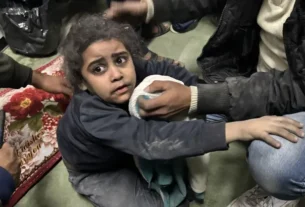
Hospital officials in Gaza said victims of Saturday’s airstrikes included two women and six children from two separate families, highlighting the civilian toll of the renewed violence.
The developments come as Israel prepares to reopen the Rafah border crossing, a critical element of the US-brokered Israel-Hamas ceasefire agreement. On Sunday, Israeli authorities announced that the Gaza-Egypt crossing had been opened on a trial basis to test operations. They said that from Monday, limited numbers of residents would be permitted to cross in both directions.
Around 20,000 Gazans requiring urgent medical treatment are seeking to leave the territory through Rafah, while thousands of Palestinians currently in Egypt are waiting to return home.
Israeli Prime Minister Benjamin Netanyahu has said only 50 medical patients per day will be allowed to exit Gaza, with each patient permitted to travel alongside two relatives. An official involved in the arrangements, speaking anonymously, said an additional 50 people who left Gaza during the war would be allowed to return daily.
Israel has stated that all travellers will undergo security vetting and remain under the supervision of European Union border monitors.
Humanitarian access inside Gaza could be further strained if the proposed ban on MSF is implemented. Israel initially suspended the charity’s work in December after it refused to comply with new registration rules requiring aid groups to submit lists of local employees. MSF argued the regulations could put Palestinian staff at risk.
Israel’s Diaspora Ministry has now said it intends to terminate MSF’s operations entirely by the end of February, claiming the measures are necessary to prevent Hamas and other militant groups from infiltrating humanitarian organisations.
MSF rejected the accusation, saying the requirements were a pretext to block humanitarian aid. The organisation said Israeli authorities were forcing aid groups to choose between exposing staff to danger or halting critical medical services for civilians in urgent need.
Avi Cohen-Scali, director-general of Israel’s Diaspora Ministry, said MSF had failed to meet basic transparency standards. He claimed the organisation violated a public commitment by refusing to submit employee lists, adding that if it had nothing to conceal, the information would have been provided to the inter-ministerial review team.
For many Palestinians, Rafah represents Gaza’s main link to the outside world. Since 2024, however, the crossing has been largely restricted by Israel, which has alleged it was used by Hamas to smuggle weapons. The border was briefly reopened early last year to allow medical evacuations.
Earlier this month, Hollywood actor Angelina Jolie visited Rafah during a humanitarian mission.
The decision to move toward an indefinite reopening follows the evacuation of the remains of the final Israeli hostage from Gaza. It marks a significant step as the ceasefire agreement, brokered by Donald Trump’s administration, enters its second phase.
Gaza has four other border crossings, but unlike Rafah, they are all shared with Israel.