


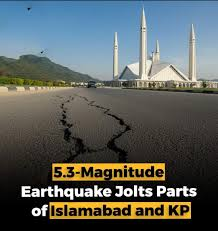
Islamabad: A 5.6-magnitude earthquake struck Islamabad, Rawalpindi and several districts of Khyber Pakhtunkhwa (KP) on Wednesday, sparking panic as strong tremors were felt across multiple areas.
According to the seismological monitoring centre, the earthquake originated in Afghanistan’s Hindu Kush region at a depth of 114 kilometres, sending noticeable shocks across northern Pakistan.
Strong tremors were reported in Peshawar, Rawalpindi, Swabi, Bajaur, Diamer, and nearby localities. Residents rushed out of buildings as a precautionary measure. However, no immediate casualties or structural damage were reported.
This latest seismic activity follows another 5.6-magnitude earthquake on February 20, which affected KP and Punjab, with tremors felt in major cities including Islamabad and Peshawar. That quake also had its epicentre in the Hindu Kush region of Afghanistan, recorded at a depth of 73 kilometres.
Pakistan remains highly vulnerable to earthquakes due to its location along the boundary of the Indian and Eurasian tectonic plates, placing it among the world’s most seismically active regions.
The country has suffered several devastating earthquakes in recent decades, including the 2005 Azad Kashmir earthquake that killed over 73,000 people, and the 2021 Harnai earthquake in Balochistan, which caused significant casualties and infrastructure damage.
Experts emphasize the importance of disaster preparedness, especially in Pakistan’s mountainous and rugged terrain, where rescue operations are often challenging. The recent tremors serve as a strong reminder of the ongoing seismic risk in the region.